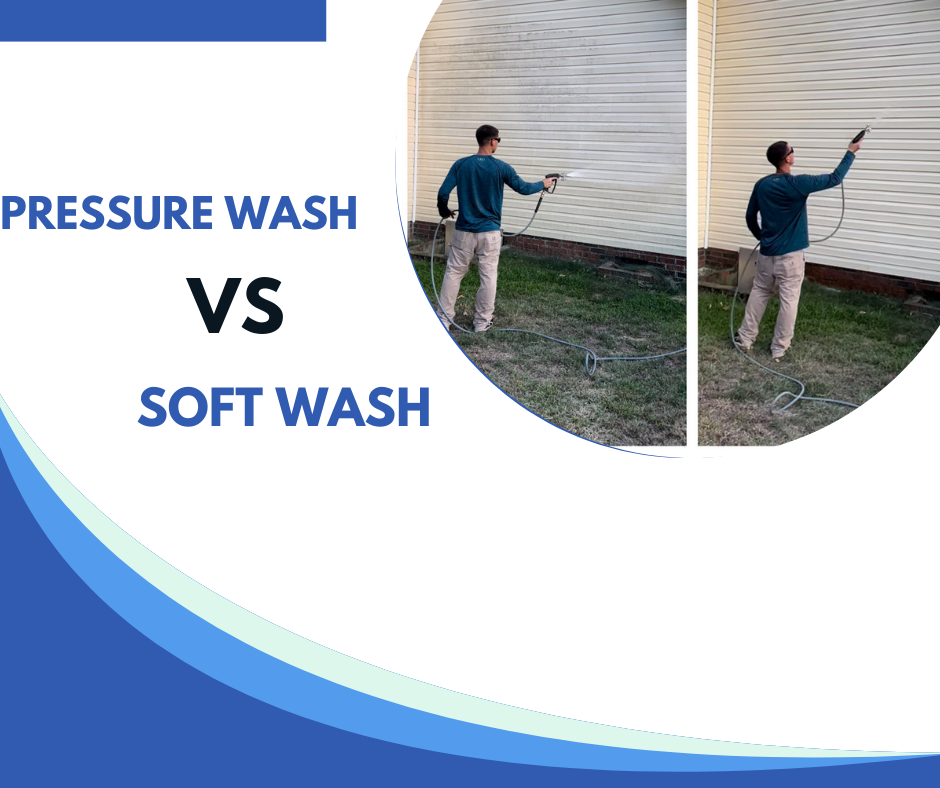
Soft Washing vs. Pressure Washing: The Truth About What Your Home Actually Needs
If you live in New Bern, NC, you’ve probably noticed how quickly your home can turn green. Between the humidity, tree coverage in neighborhoods like Trent Woods and River Bend, and moisture from the Neuse River, algae growth is a constant battle.
When it’s time to clean your home, most people say:
“I need to pressure wash my house.”
But here’s the truth:
Most homes should not be cleaned with high pressure.
In this guide, we’ll break down the real difference between soft washing and pressure washing, which method is safest for your home, and what works best in coastal North Carolina.
At Pro Wash Pressure Washing LLC, we specialize in safe, environmentally secure exterior cleaning — and understanding this difference protects your home from costly damage.
What Is Pressure Washing?
Pressure washing uses high-pressure water (often 2,500–4,000 PSI) to remove dirt, grime, mud, and surface buildup.
It works well for:
Concrete driveways
Sidewalks
Brick
Stone
Some heavy-duty commercial surfaces
Pressure washing removes debris through force.
But here’s the issue:
Force does not kill organic growth.
Algae, mold, and mildew require chemical treatment to eliminate them at the root.
Blasting algae with high pressure may make it look clean temporarily — but it often returns quickly because it was never treated properly.
What Is Soft Washing?
Soft washing is a low-pressure cleaning method that uses properly diluted cleaning solutions to safely remove and kill organic growth.
Instead of relying on pressure, soft washing relies on:
Correct chemical ratios
Dwell time
Low-pressure application
Controlled rinsing
Soft washing typically uses under 500 PSI — often much less — and applies cleaning solution using a black soap tip and downstream injector.
The result?
✔ Safer for siding
✔ Longer-lasting results
✔ Less risk of damage
✔ Better algae removal
Why This Matters in New Bern, NC
Homes in coastal North Carolina deal primarily with:
Green algae
Black streaks
Mildew buildup
Pollen residue
These are organic growth issues — not dirt problems.
Because of the humidity in areas like James City and Fairfield Harbour, simply blasting your siding with pressure is not the correct solution.
The real solution is killing the growth safely.
The Hidden Damage of High Pressure
Many homeowners assume more pressure = better cleaning.
That’s not true.
High pressure on siding can:
Crack Vinyl Panels
Vinyl siding isn’t designed for thousands of PSI.
Force Water Behind Walls
Spraying upward can push water behind siding, leading to interior mold problems.
Cause Oxidation Striping
If your siding has oxidation (chalky residue), high pressure can permanently stripe it.
Void Manufacturer Warranties
Many siding manufacturers specifically warn against high-pressure washing.
Most exterior damage we see isn’t from storms — it’s from improper washing.
When Pressure Washing IS Appropriate
Pressure washing has its place.
It works well on:
Concrete driveways
Sidewalks
Pool decks
Brick surfaces
Dumpster pads
Commercial flatwork
Concrete can handle higher PSI.
Siding usually cannot.
At Pro Wash Pressure Washing LLC, we pressure wash concrete and flat surfaces — but we soft wash homes.
Different surfaces require different techniques.
How Soft Washing Actually Works
Let’s break it down.
Soft washing involves:
Pre-wetting landscaping
Applying diluted cleaning solution using a downstream injector
Using only a black soap tip (never high-pressure tips)
Allowing proper dwell time
Removing injector from bucket immediately after application
Rinsing plants thoroughly
Applying Plant Protect for added protection
Rinsing siding from top down
It’s controlled. Measured. Safe.
It’s not about blasting.
It’s about treating.
Why Bleach Gets a Bad Reputation
Homeowners often worry about bleach.
Here’s the truth:
Bleach is safe when:
Properly diluted
Applied with low pressure
Not put into the pressure washer tank
Mixed externally in a bucket
Followed by plant protection and rinsing
Bleach becomes unsafe when:
Over-applied
Mixed incorrectly
Allowed to dry
Sprayed at high pressure
Soft washing uses responsible chemical management — not reckless application.
Common Myths About Soft Washing
Myth 1: Soft Washing Is Just Spraying Chemicals
False. It’s controlled dilution with proper dwell time and rinsing.
Myth 2: High Pressure Cleans Better
False. It cleans faster — but not safer or longer-lasting.
Myth 3: You Can Clean a House with Just Water
In humid New Bern conditions, water alone will not kill algae.
Myth 4: All Pressure Washing Companies Do the Same Thing
Technique matters. Equipment setup matters. Dilution ratios matter.
How Long Do Results Last?
In coastal North Carolina:
Proper soft washing can last 12–18 months
Pressure blasting without treatment may only last a few months
If algae isn’t killed at the root, it returns quickly.
Soft washing provides longer-lasting protection.
How to Tell Which Method Your Home Needs
Ask yourself:
Do I see green or black organic growth? → Soft wash
Is the surface concrete? → Pressure wash
Is it vinyl siding? → Soft wash
Is it a roof? → Never pressure wash
Shingles should always be soft washed.
Pressure washing a roof can permanently damage it.
The Environmental Question
We take environmentally secure cleaning seriously in New Bern.
Responsible soft washing includes:
Proper dilution ratios
Controlled runoff
Pre-wetting landscaping
Immediate plant rinsing
Use of Plant Protect
Never putting chemicals in machine tanks
Being environmentally secure doesn’t mean avoiding chemicals completely.
It means using them responsibly and professionally.
DIY vs Professional Soft Washing
DIY Risks:
Wrong injector ratio
Using high-pressure tips
Putting chemicals in tank
Forgetting plant protection
Spraying upward
Letting solution dry
Professional Advantages:
Correct downstream setup
Black tip only for application
Controlled dwell time
Immediate injector removal
Plant Protect application
Insurance coverage
Sometimes DIY is fine for small projects.
But for full home washing in humid coastal climates, professional technique reduces risk significantly.
Why Homes in New Bern Need Regular Washing
Between:
High humidity
Warm temperatures
Tree shade
River moisture
Pollen seasons
Homes here get dirty faster than in dry climates.
Most homes should be washed every 12–18 months to prevent permanent staining.
North-facing sides often need more frequent service.
Safety Always Comes First
If attempting DIY soft washing:
✔ Never use high-pressure tips
✔ Only use black soap tip
✔ Never put chemicals in the tank
✔ Mix in external bucket
✔ Use correct downstream injector
✔ Remove injector immediately after spraying
✔ Rinse plants immediately
✔ Never spray upward
✔ Never use ladder with pressure washer
Pressure washers can cause serious injury.
Respect the equipment.
So… What Does Your Home Actually Need?
If you have vinyl siding, painted wood, stucco, or roofing shingles:
You likely need soft washing.
If you have concrete driveways or sidewalks:
Pressure washing may be appropriate.
The key is using the right method on the right surface.
Final Thoughts
In New Bern, NC, most residential exterior cleaning should be done using soft washing — not high pressure.
Cleaning your home is about
Protecting your investment
Preserving warranties
Avoiding water intrusion
Maintaining curb appeal
Using environmentally secure methods
At Pro Wash Pressure Washing LLC, we combine soft washing expertise with professional safety standards to protect homes throughout New Bern, Trent Woods, River Bend, James City, and surrounding areas
If you’re unsure which method your home needs, we’re happy to provide a free assessment.
Protect your siding. Protect your landscaping. Do it the right way.